What Is Sector Rotation? The Strategy That Beats Buy-and-Hold
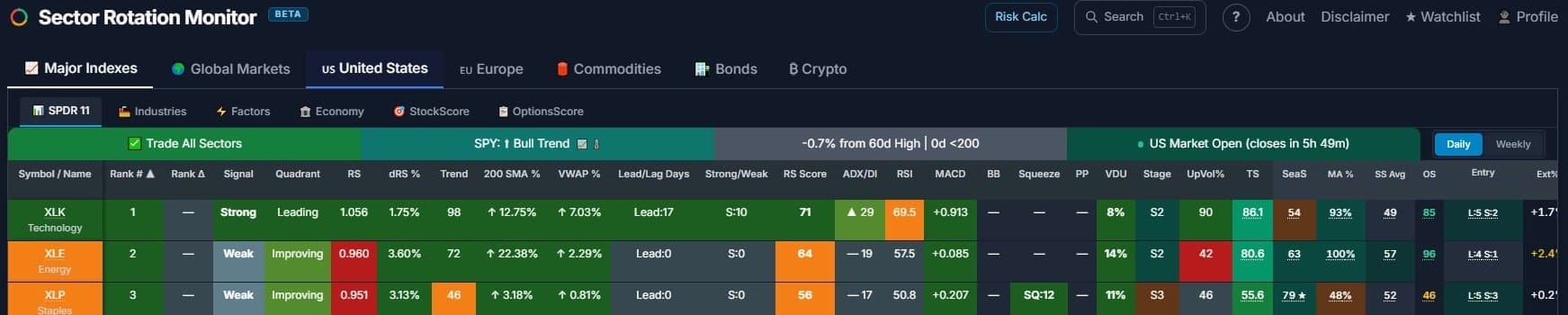
The market is not one market. It is eleven.
The S&P 500 is a weighted basket of 11 sectors — Tech, Financials, Energy, Healthcare, Utilities, and so on. They do not move together. In any given 6-month window, the spread between the best-performing sector and the worst can be 20–40 percentage points. Buy-and-hold averages all of that into a single number. Sector rotation is the discipline of owning the right side of that spread.
What buy-and-hold actually buys you
Buy-and-hold is a great default. It beats most active managers, it has near-zero costs, and it removes emotion from the process. Over 30+ year windows, the S&P 500 has compounded around 9–10% per year.
But it has two well-documented weaknesses:
- Drawdowns are brutal. −37% in 2008. −34% in March 2020. −25% in 2022. If you buy near a top, you can spend 5–10 years just getting back to even.
- You are always 100% allocated to whatever the index is heaviest in. In 2000, that was Tech at 33% of the index — right before it collapsed 80%. Today the top-10 names again make up over 30% of the S&P 500. Buy-and-hold is a concentration bet most people don't realise they're making.
Sector rotation does not abandon the index. It tilts the index toward whichever sectors are leading right now and away from whichever are breaking down.
What sector rotation actually is
Sector rotation is the observation that capital flows between groups of stocks in a roughly predictable pattern as the economic cycle moves through its phases:
| Phase | Conditions | Sectors that typically lead |
|---|---|---|
| Early expansion | Rates falling, growth accelerating | Consumer Discretionary, Financials, Industrials |
| Mid expansion | Steady growth, rising rates | Technology, Communication Services |
| Late cycle | Inflation rising, rates peaking | Energy, Materials, parts of Industrials |
| Recession / risk-off | Growth falling, fear rising | Utilities, Consumer Staples, Healthcare |
This is not a theory. Fidelity, Stovall, and decades of academic work all show the same pattern. Capital chases earnings momentum, and earnings momentum rotates with the cycle.
The hard part isn't knowing the table exists. The hard part is knowing which row you're in right now, and noticing the shift before everyone else does.
That's the gap Sector Rotation Monitor was built to close.
How a quantitative sector rotation strategy works
A modern rotation framework — including the one running on Sector Rotation Monitor — has three layers:
1. Score every sector, every day
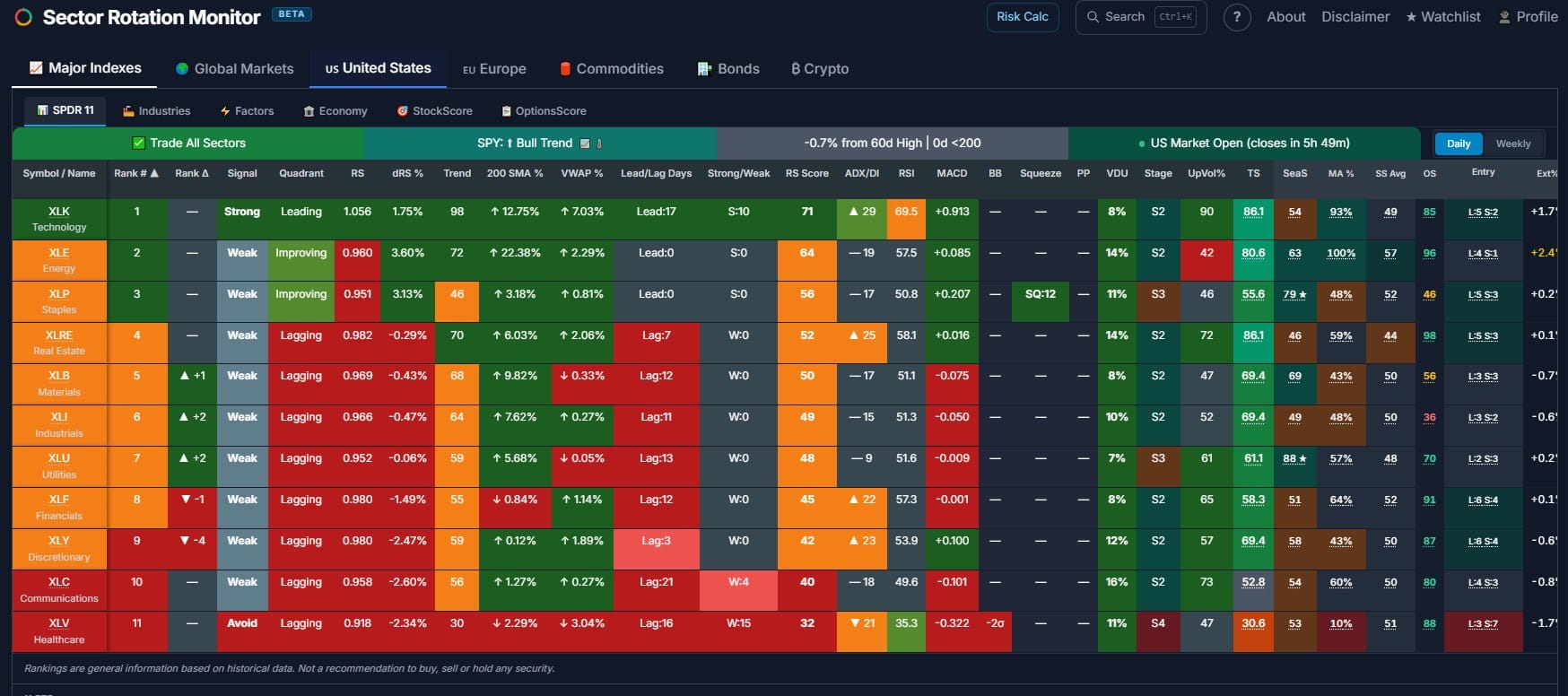
Each of the 11 SPDR sector ETFs (XLK, XLF, XLE, XLV, XLY, XLP, XLU, XLI, XLB, XLRE, XLC) gets a composite score built from:
- Relative strength vs SPY (is it beating the index?)
- Trend (is it above its 50/200-day moving averages?)
- Momentum (is the rate of change positive and accelerating?)
- Breadth (are the underlying stocks confirming, or is the move thin?)
The output is a single ranked table — sector 1 to 11 — refreshed every market morning.
2. Confirm with regime
Rankings alone are noisy. A sector can be #1 in a falling market and still lose money. So the second layer is a macro economic regime model — the MEI (Macro Economic Indicator) — that classifies the environment as risk-on, balanced, or defensive based on yield curves, credit spreads, FRED data, and breadth.
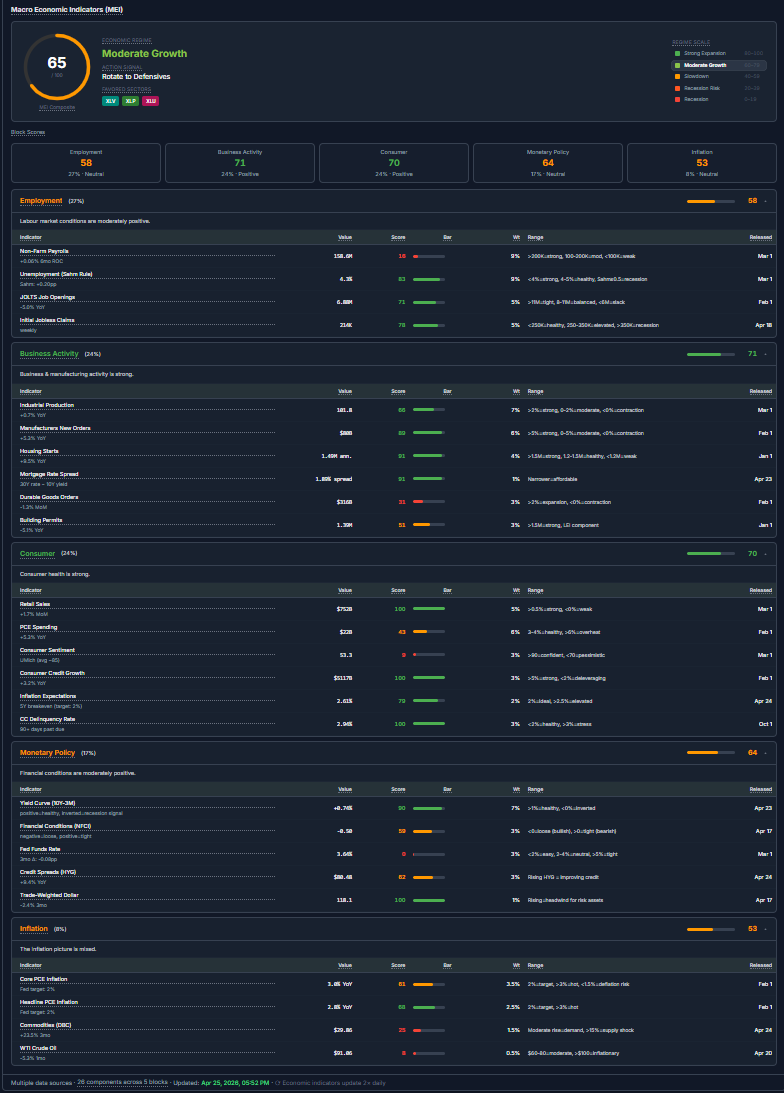
You only act aggressively on top-ranked sectors when the regime supports risk-taking. When the regime turns defensive, the strategy shifts weight toward Utilities, Staples, and Healthcare — the historically defensive trio.
3. Drill from sector to stock
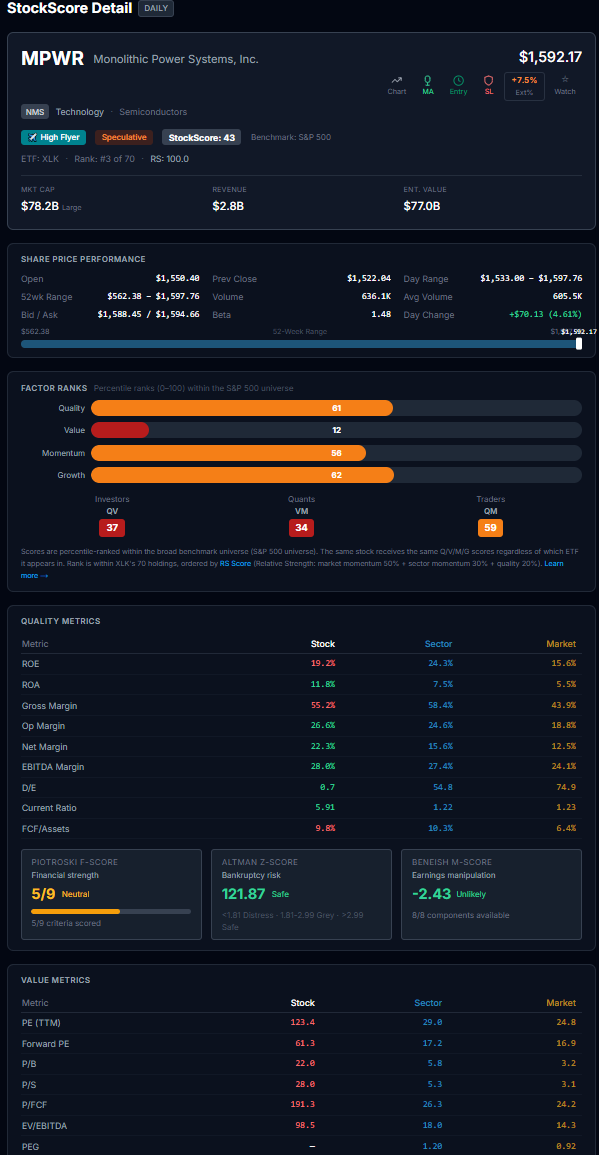
Once you've identified the leading sectors, the final step is picking the names inside them with the strongest confluence — momentum, trend, fundamentals, and analyst signal aligned. That's what the stockscore layer does. Sector rotation gets you in the right neighbourhood. Stock selection gets you the right house.
Why this beats buy-and-hold over a full cycle
Three reasons, in order of importance:
- Avoiding the worst sectors matters more than picking the best. Removing the bottom-2 ranked sectors from your allocation has historically been worth more than overweighting the top-2. Sector rotation is, at heart, a risk-management discipline disguised as a return-seeking one.
- Smaller drawdowns compound faster. A portfolio that draws down 15% recovers in months. One that draws down 40% takes years. Less time underwater = more time compounding.
- You stay invested. The biggest reason buy-and-hold underperforms its own backtest is behaviour — investors sell at the bottom. A rule-based rotation framework gives you something to do in a downturn other than panic, which is the single most valuable thing a strategy can offer.
The honest caveats
- Whipsaw risk. In choppy, trendless markets, rotation strategies can underperform a passive index. The fix is patience and longer holding periods (we use end-of-day, not intraday, signals).
- Tax drag. Rotating quarterly in a taxable account is more tax-efficient than rotating monthly. In an IRA / ISA / SIPP it's a non-issue.
- No strategy beats the market every year. The goal is to beat it over a full cycle with materially lower drawdowns. That's a much more achievable, and much more useful, objective.
How to start, today
You don't need to overhaul your portfolio to use sector rotation. The simplest entry point is a core-and-tilt structure:
- 70% in your existing index core (SPY, VOO, VTI — whatever you already hold).
- 30% tilted into the top-3 ranked sectors from today's table.
- Re-rank monthly. Rotate only when a sector falls out of the top 3 and a new one enters with confirmation.
That single change — done with discipline — could improve risk-adjusted returns vs. the cap-weighted index, with materially smaller drawdowns. Over 20 years of compounding, even small edges add up.
See today's rankings
The full SPDR 11 ranking table, regime classification, and per-stock scores update every market morning at sectorrotationmonitor.com/dashboard — signup required.
Or read the daily auto-generated free commentary at sectorrotationmonitor.com/market-pulse to see which sectors are rotating right now.